
University of Tübingen (Eberhard Karls Universität Tübingen)
Quick Snapshot & Key Statistics
| Official Name | Eberhard Karls Universität Tübingen (University of Tübingen) |
| Institution Type | Public Comprehensive Research University / University of Excellence (Exzellenzuniversität) |
| Established | 1477 (Founded by Count Eberhard V) |
| Motto | Attempto! ("I dare!") |
| Total Enrollment | ~28,500+ Students (~15% International Students from 130+ nations) |
| Academic Faculties | 7 Faculties | Over 200 Degree Programs |
| Nobel Laureates | Associated with 11 Nobel Laureates (e.g., Christiane Nüsslein-Volhard, Günter Blobel, Karl Ferdinand Braun) |
| Institutional Affiliations | German U15, German Excellence Strategy, Matariki Network of Universities, EUCONEXUS |
| Main Location | Tübingen, Baden-Württemberg, Germany |
| Global Rankings | Ranked #95–100 Worldwide (THE) | Top 10 in Germany |
| Tuition Fees (Non-EU) | €1,500 per semester (~€3,000 / year under Baden-Württemberg state law) |
| Tuition Fees (EU/EEA) | €0 / year (Tuition-Free for EU/EEA citizens) |
| Semester Contribution | ~€199 to €210 per semester (Administrative & student welfare fees) |
About University of Tübingen
Founded in 1477, the University of Tübingen (Eberhard Karls Universität Tübingen) is one of Europe's oldest and most prestigious institutions of higher learning and scientific research. Officially designated as a University of Excellence under Germany's national Excellence Strategy, Tübingen is internationally acclaimed for pioneering research in AI & Machine Learning, Computational Neuroscience, Microbiology, Cancer Research, Quantum Physics, Archaeology, and Protestant/Catholic Theology.
Situated in the historic town of Tübingen in southwestern Germany, the university shapes the cultural and scientific fabric of the region. It is a founding anchor of Cyber Valley—Europe's largest research consortium in artificial intelligence—and maintains direct collaborative ties with local Max Planck Institutes (Intelligent Systems, Biology, Cybernetics), the Bernstein Centre for Computational Neuroscience, and the German Centre for Diabetes Research (DZD).
Why Choose University of Tübingen?
- One of Germany's oldest universities (established in 1477)
- Member of Germany's Universities of Excellence
- World-renowned research university
- Strong international reputation
- Global leader in artificial intelligence and neuroscience
- Affordable public university education
- Numerous English-taught Master's programmes
- Excellent research facilities
- Outstanding graduate employability
- Beautiful and student-friendly university town
Location & Campus Structure of University of Tübingen
The University of Tübingen is located in Tübingen, a scenic town in the state of Baden-Württemberg, situated approximately 30 km south of Stuttgart along the Neckar River.
The university does not have a single isolated campus; instead, its facilities are integrated across four primary town hubs:
- City Centre Campus (Tal Campus): Located around the historic Old Town (Altstadt) and Wilhelmstraße. Centred on the iconic Neue Aula building, housing Humanities, Law, Theology, Economics, and the Main University Library (UB).
- Morgenstelle Campus (Berg Campus): A modern high-tech research hill in northern Tübingen housing the Faculty of Science (Computer Science, Physics, Chemistry, Biology, Mathematics, and Pharmacy).
- Medical Campus (Schnarrenberg): Located adjacent to Morgenstelle, hosting the specialised clinics of the University Hospital Tübingen, medical research units, and clinical trial facilities.
- Cyber Valley / AI District: Situated near the Max Planck campus, dedicated to machine learning, computer vision, robotics, and the ELLIS Institute.
Popular & Unique Degree Programs
The University of Tübingen offers over 200 study programs across 7 academic faculties: Faculty of Protestant Theology, Faculty of Catholic Theology, Faculty of Law, Faculty of Medicine, Faculty of Humanities, Faculty of Economics and Social Sciences, and Faculty of Science.
Top English-Taught Programs (International Favourites)
- M.Sc. Machine Learning: One of Europe's top artificial intelligence degrees, connected directly to Cyber Valley research groups and the Max Planck Institute for Intelligent Systems.
- M.Sc. Neural Information Processing: Interdisciplinary program hosted at the Graduate School of Neural & Behavioural Sciences, bridging computational neuroscience, biophysics, and machine learning.
- M.Sc. Neural and Behavioural Sciences: Focuses on cellular neurobiology, cognitive systems, behavioural physiology, and neuroimaging.
- M.Sc. Data Science in Business and Economics: Merges statistical modelling, big data analytics, and corporate finance.
- M.Sc. Controlling Microbes to Fight Infections (CMFI): Specialised track linked directly to the CMFI Cluster of Excellence, researching microbiome science and novel antibiotics.
- M.Sc. Molecular Medicine: Advanced translational biomedical research, cellular pathology, and oncology.
Top German-Taught Degree Programs
- Human Medicine & Dentistry (Staatsexamen): Highly competitive, world-renowned clinical training program operated at the University Hospital Tübingen (Universitätsklinikum Tübingen).
- Law (Rechtswissenschaft - Staatsexamen / LL.M.): Ranked among the top law faculties in Germany with centuries of academic history.
- B.A. / M.A. Allgemeine Rhetorik (General Rhetoric): Home to the only independent Department of Rhetoric in Germany, founded by intellectual Walter Jens.
- B.A. / M.A. Archaeological Sciences & Prehistory (Ur- und Frühgeschichte): World-class research department managing UNESCO World Heritage Ice Age discoveries.
- B.Sc. / M.Sc. Psychology & Clinical Psychotherapy: High-demand program featuring strong admission cutoffs (Numerus Clausus).
- Protestant & Catholic Theology (Staatsexamen / Mag. Theol.): Historically prestigious faculties associated with the famous Tübinger Stift.
Language Requirements (English & German)
Language prerequisites depend on the primary medium of instruction for your chosen program at the University of Tübingen.
German Language Requirements (German-Taught Programs)
For degree programs taught in German (including all standard Bachelor's degrees and State Examination programs like Medicine, Dentistry, and Law), non-native applicants must prove C1 CEFR German proficiency:
- DSH: DSH-2 or DSH-3.
- TestDaF: Minimum level of 4x4 (TDN 4 in all 4 examination sections).
- telc: telc Deutsch C1 Hochschule.
- Goethe-Zertifikat: Goethe-Zertifikat C2.
English Language Requirements (English-Taught Programs)
For international Bachelor's and Master's programs taught in English, applicants must submit proof of B2 or C1 CEFR English proficiency:
| IELTS Academic | Overall 6.5 or 7.0 (program-dependent) |
| TOEFL iBT | 88 to 100 points or higher |
| Cambridge English | C1 Advanced (CAE) or C2 Proficiency (CPE) |
| PTE Academic | 65 points or higher |
Fee Structure at University of Tübingen
Because the University of Tübingen is located in the state of Baden-Württemberg, state legislation mandates tuition fees for international students from non-EU/EEA countries enrolled in standard degree programs.
Bachelor's Programmes
- EU/EEA Students: No tuition fees
- Non-EU Students: €1,500 per semester (for most degree programmes)
- Semester contribution: Approximately €199 to €210 per semester
Master's Programmes
- Consecutive Master's Programmes — EU/EEA Students: No tuition fees
- Consecutive Master's Programmes — Non-EU Students: €1,500 per semester (for most programmes)
- Semester contribution: Approximately €199 to €210 per semester
- Exemptions: Certain students may qualify for exemptions under Baden-Württemberg regulations.
Mandatory Administrative & Living Costs at University of Tübingen
- Semester Contribution (Semesterbeitrag): ~€199 to €210 per semester (paid twice annually for re-registration).
- Blocked Account (Sperrkonto) for Visa: Non-EU international students must deposit €11,904 per year into an official Blocked Account to draw €992 per month for living costs.
- Monthly Living Costs in Tübingen: Tübingen is a classic university town. On average, students spend between €850 and €1,100 per month.
Research & Industry Partnerships
University of Tübingen collaborates with leading research organisations and industry partners, including:
- Max Planck Society
- German Centre for Neurodegenerative Diseases (DZNE)
- University Hospital Tübingen
- Bosch
- Mercedes-Benz Group
- Porsche
- Siemens
- CureVac
- Amazon
- Cyber Valley
These collaborations provide students with opportunities for research, internships, innovation projects, and strong graduate employment prospects.
Let's plan your path to studying at University of Tübingen
From matching your profile to the right faculty to preparing a compelling application, our counsellors guide every step of your journey.
Frequently Asked Questions (FAQs)
Cyber Valley is Europe's largest research consortium in artificial intelligence, computer vision, and robotics. Co-founded by the University of Tübingen, the University of Stuttgart, the Max Planck Society, and industry partners such as Amazon, Bosch, Porsche, Mercedes-Benz, it centres its machine learning research units directly in Tübingen.
The ELLIS Institute (European Lab for Learning and Intelligent Systems) in Tübingen is a world-class AI research centre funded with €100 million from the Hector Foundation and the state of Baden-Württemberg. It provides top global machine learning scientists with direct research autonomy and computational infrastructure in Tübingen.
This Cluster of Excellence at Tübingen researches how machine learning algorithms can transform traditional scientific discovery. It develops AI tools to analyse complex data across quantum physics, astrophysics, climate modelling, and medicine.
CMFI (Controlling Microbes to Fight Infections) focuses on understanding host-microbiome interactions to discover new anti-infective strategies and combat multidrug-resistant bacterial pathogens using novel targeted antibiotics.
iFIT (Image-guided and Functionally Instructed Tumour Therapies) is Germany's only oncology-focused Cluster of Excellence. It integrates molecular imaging, functional genomics, and immunotherapy to develop personalised treatments for therapy-resistant cancers.
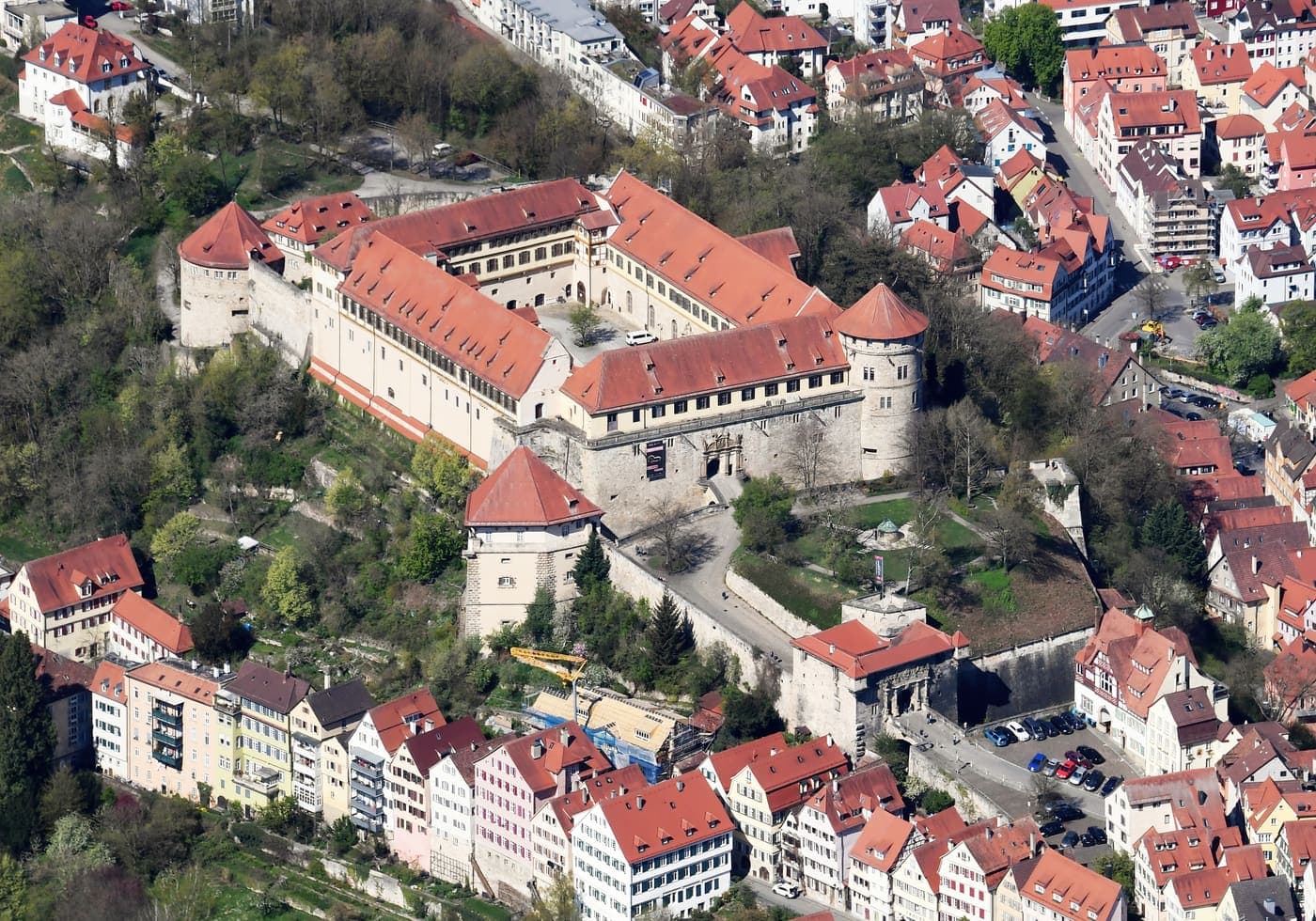
The Museum of the University of Tübingen (MUT) is located inside the 16th-century Hohentübingen Castle. It houses UNESCO World Heritage artefacts, including 40,000-year-old Ice Age mammoth ivory carvings (the Vogelherd figures) and ancient Egyptian burial chambers curated by university archaeologists.
BCCN Tübingen is an interdisciplinary research centre bringing together the University of Tübingen, the Max Planck Institute for Biological Cybernetics, and the Hertie Institute for Clinical Brain Research to model neural information processing and sensory perception.
The Hertie Institute at Tübingen is one of Europe's premier centres for clinical neurology research. Operated jointly by the university and the Hertie Foundation, it focuses on neurodegenerative diseases such as Parkinson's, Alzheimer's, and ALS.
Tübingen's "Industry on Campus" model allows private corporate research units such as Robert Bosch GmbH and Amazon Development Centre to set up research laboratories on university grounds, fostering direct collaboration between academic researchers and industry engineers.
ZPMB is a world-class plant science institute at the Morgenstelle Campus, bringing together over 15 research groups studying plant genetics, cellular signalling, developmental biology, and crop stress resilience.
Yes. Under Baden-Württemberg state law, registered doctoral candidates at the University of Tübingen are exempt from the €1,500 per semester non-EU tuition fee and pay only the standard administrative semester fee.
The Centre for Rhetorical Science Communication Research on Artificial Intelligence (RHET AI Centre) is a national competence centre at Tübingen investigating how AI research is communicated to the public, addressing societal ethics, media framing, and public trust in technology.
The University Library Tübingen (UB) holds over 3.8 million volumes and acts as a national repository for Theology, Religious Studies, and Criminology. It features silent study zones, digitised medieval manuscript labs, and specialised research databases.
University of Tübingen is particularly renowned for Artificial Intelligence, Machine Learning, Computer Science, Medicine, Neuroscience, Psychology, Bioinformatics, Molecular Biology, Economics, and Theology.
University of Tübingen is an excellent choice for students seeking a globally recognised degree, affordable public education, cutting-edge research opportunities, and outstanding career prospects. Its historic campus, international academic community, leadership in AI and life sciences, and beautiful location make it one of the best universities in Germany for higher education.
Explore Other Universities in Germany
Photo credits: Schloss Hohentübingen, University of Tübingen by Carsten Steger, CC BY-SA 4.0; SAP headquarters, Walldorf by Vladislav Bezrukov from Walldorf, Germany, CC BY 2.0. Via Wikimedia Commons. All image credits
